

Moisture is still the #1 silent destroyer in bathrooms, especially in coastal New England towns like Westport where seasonal humidity swings can amplify condensation and slow drying times. The EPA reports that indoor humidity above 60% promotes mold growth(U.S. EPA, 2024), and bathrooms routinely spike well beyond that during showers if ventilation and surfaces are not designed correctly. If you are researching bathroom remodeling services Westport, the smartest way to reduce callbacks, repairs, and musty odors is to choose materials that are truly moisture-resistant, not just “water-friendly.”
In this 2026 guide, you will learn which waterproof bathroom materials perform best in Westport bathrooms, how they compare on durability and maintenance, what trends are changing specifications in 2026, and the common mistakes homeowners make when searching “ bathroom remodeling near me” or “ bathroom contractors near me” without a moisture plan.
Why Westport bathrooms demand moisture-first material choices?
Bathrooms fail in predictable ways: grout cracks, moisture migrates behind tile, drywall softens, and wood swells. In Westport and the South Coast region, you also see more salt-air corrosion near the shoreline and higher ambient humidity in summer, which can slow drying and increase the time surfaces stay damp.
Moisture dynamics: vapor, liquid water, and “wet time”
Most homeowners focus on liquid water (splashes and leaks), but water vapor is often the bigger long-term problem. Steam can penetrate porous grout, unsealed stone, and paper-faced drywall. The longer a bathroom stays wet after use, the higher the risk of microbial growth and material degradation. The EPA’s guidance that mold can begin growing on damp materials within 24–48 hours is a practical benchmark for bath design decisions (U.S. EPA, 2024).
What this means for remodeling specifications?
Moisture-resistant materials only work when paired with correct assemblies: waterproofing membranes, proper thinset, movement joints, and ventilation. ASHRAE continues to recommend local exhaust ventilation in bathrooms vented to the outdoors (ASHRAE, 2023). In remodeling, that translates to selecting materials that tolerate humidity spikes anddry quickly, while building systems that prevent moisture from getting into the wall cavity in the first place.
Moisture-resistant wall and shower surround materials
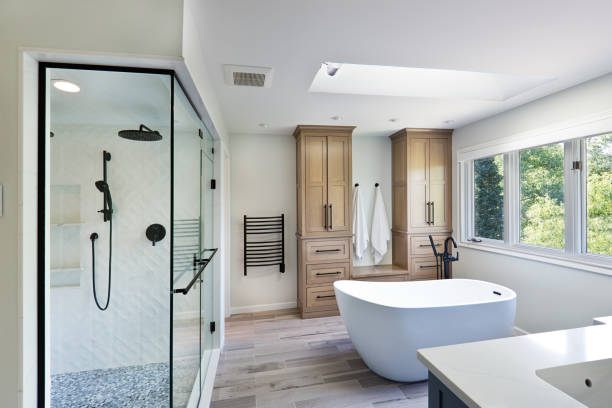
In Westport bathroom remodeling projects, shower walls are the highest-risk zone. The best-performing solutions in 2026 generally fall into three categories: tile with a modern waterproofing system, large-format slab surfaces, and engineered wall panels designed for wet areas.
Porcelain tile + sheet or liquid waterproofing (the “systems” approach)
Porcelain is among the most water-resistant finish materials because it has very low absorption. The Tile Council of North America (TCNA) emphasizes that performance depends on the assembly, not just the tile, including a waterproof membrane and correctly detailed seams and penetrations (TCNA Handbook, 2024). For Westport homes, this is the most flexible option for style and long-term repairability.
Sintered stone and porcelain slabs (fewer grout lines, faster drying)
Sintered stone and large-format porcelain slabs reduce grout lines, which reduces maintenance and limits pathways for moisture. These surfaces are increasingly common in 2026 for “spa” bathrooms because they deliver a clean look with less scrubbing. The tradeoff is that slab work requires high-skill fabrication and installation, and repairs can be more complex than standard tile.
Wet-area wall panels (acrylic, composite, and laminated panels)
High-quality wall panels can be a strong choice when you want a fast installation, fewer joints, and predictable maintenance. The best panel systems use sealed seams and compatible trims, and they are especially helpful for rental properties where owners want consistent performance across turnovers.
Substrates and waterproofing: the hidden layer that prevents expensive failures
If you only upgrade finishes, you can still end up with rot behind “beautiful” new tile. A moisture-resistant bathroom starts with substrate selection and waterproofing continuity, especially around niches, benches, and plumbing penetrations.
Backer boards: cement board vs foam board vs “moisture-resistant drywall”
Moisture-resistant (MR) drywall is not a shower substrate. In 2026, best practice for wet zones remains cementitious backer units or foam backer boards designed for showers, paired with an approved waterproofing method. Foam boards can simplify waterproofing because many are waterproof by design, but seams and fasteners still need correct treatment.
Membranes: sheet vs liquid-applied waterproofing
Sheet membranes offer consistent thickness and are excellent for controlling water at seams when installed properly. Liquid-applied membranes can be great for complex shapes, but film thickness and cure time must be managed carefully. The key is to treat waterproofing like roofing: continuous, overlapped, and sealed, not “painted on and hoped for.”
Drainage and slope: the moisture-resistant detail most DIYs miss
Many shower problems are not “waterproofing failures” but slope and drainage failures. Benches must be pitched; curbs must be waterproofed; linear drains must be set precisely. When clients search “bathroom remodeling services near me,” ask specifically how the contractor verifies slope and flood-tests wet areas before tile.
Flooring and grout choices that resist water, stains, and swelling
Bathroom floors are exposed to puddles, wet bathmats, and toilet overflows. A moisture-resistant floor is not only about water resistance, but also dimensional stability and safe slip resistance.
Porcelain floor tile (still the gold standard)
Porcelain tile remains a top performer in bathrooms because it is stable, durable, and compatible with radiant heat. Choose a slip-resistant finish suitable for wet areas and specify movement joints to reduce cracking. If you have an older Westport home with floor deflection concerns, the structure may need reinforcement before tile.
Luxury vinyl tile (LVT): where it fits and where it does not
LVT is popular for warm feel underfoot and faster installation. Many products are marketed as “waterproof,” but the real issue is what happens belowthe plank if water gets underneath. For full bathrooms, LVT can perform well with proper perimeter detailing and a realistic plan for overflow events.
Epoxy grout vs cement grout (maintenance vs install complexity)
Epoxy grout is more stain-resistant and less permeable than cement grout, making it a strong choice for busy family bathrooms and rentals. It is also more demanding to install and clean during application, so labor costs can be higher. A practical compromise is using high-performance cement grout with a robust sealer when budget is tight.
2026 material and specification trends shaping Westport bathroom remodels
In 2026, “moisture resistant” is evolving into “moisture managed,” meaning homeowners want assemblies that dry faster, clean easier, and reduce long-term maintenance.
Trend 1: Larger formats and fewer grout lines
Large-format tile and slab walls continue to gain share because fewer grout lines means fewer cleaning problems and fewer pathways for moisture and staining. This aligns with what many homeowners want when they search “bathroom contractors near me”: a bathroom that looks new longer with less upkeep.
Trend 2: Health-forward specifications (low-VOC, mold-resistant assemblies)
Low-VOC sealants and coatings remain a priority as homeowners focus on indoor air quality. The EPA continues to advise controlling moisture as the primary mold strategy, and IAQ awareness has stayed elevated post-pandemic (U.S. EPA, 2024). In practice, that means selecting moisture-tolerant materials and avoiding assemblies that trap vapor inside walls.
Trend 3: Smarter ventilation and humidity sensing
Humidity-sensing exhaust fans and timer controls are becoming standard in better remodels because they reduce “wet time” without relying on homeowner behavior. ENERGY STAR notes that efficient ventilation fans can improve comfort and help control moisture when used properly (ENERGY STAR, 2025). In Westport, this is especially valuable in shoulder seasons when windows stay closed.
Comparison table
Use the table below to match materials to where they perform best. This is the same decision framework we use in consultations for bathroom remodeling services Westport: choose finishes, then validate the assembly behind them.
| Bathroom zone | Top moisture-resistant material options (2026) | Why it works | Common tradeoff |
|---|---|---|---|
| Shower walls | Porcelain tile + sheet/liquid membrane; porcelain/sintered slab; sealed wall panel systems | Low absorption surfaces plus controlled waterproofing layer | Higher labor skill required; slab repairs can be complex |
| Shower floor | Mosaic porcelain tile; slip-rated small-format porcelain; mortar bed + membrane system | Better traction and slope control to drain | More grout lines to maintain |
| Main bathroom floor | Porcelain tile; properly detailed LVT; natural stone with robust sealing plan | Dimensional stability and water resistance for daily use | Stone needs maintenance; LVT vulnerable if water gets underneath |
| Vanity area and backsplash | Quartz tops; porcelain slab; tile with sealed grout | Non-porous surfaces resist staining and swelling | Seams and caulk joints still require upkeep |
| Ceiling and paint | Bath-rated paint; moisture-resistant primer; properly ducted exhaust fan | Reduces peeling and mildew staining | Paint is not a substitute for ventilation |
Common mistakes to avoid (and pro tips that save money)
Most moisture problems are preventable. The failures we see after remodels usually come from missing details, not “bad luck.”
Mistake 1: Treating “water-resistant” as “waterproof”
Greenboard, standard drywall, and basic caulk are not shower waterproofing. Waterproofing should be a designed, continuous layer that is inspected before tile goes up. Pro tip: require a documented waterproofing method and ask whether the installer follows TCNA details for your shower type (TCNA Handbook, 2024).
Mistake 2: Skipping ventilation upgrades
A beautiful remodel can still smell musty if moist air is not exhausted. ASHRAE guidance emphasizes spot ventilation for bathrooms to control moisture (ASHRAE, 2023). Pro tip: choose a quiet fan (low sones) so people actually use it, and add a humidity sensor or timer.
Mistake 3: Using natural stone without a maintenance plan
Natural stone can work, but it is not set-and-forget. Some stones are more porous and can discolor in wet areas. Pro tip: if you love stone, reserve it for low-splash zones, use a penetrating sealer appropriate to the stone, and commit to resealing intervals based on manufacturer guidance.
Mistake 4: Not planning for “overflow events”
Toilet clogs and supply line failures happen. Pro tip: add an accessible shutoff, use quality braided supply lines, and detail flooring transitions to limit water migration. If you own a rental, choose finishes that tolerate occasional water incidents without swelling.
Conclusion
Moisture resistance is not one product. It is a system of smart material choices, correct installation methods, and ventilation that reduces wet time.
If you are evaluating bathroom remodeling services near meand want a moisture-first plan tailored to Westport homes, Remodeling Consultants can help you compare waterproof bathroom materials, review contractor scopes, and specify assemblies that prevent hidden damage. The next step is simple: document your bathroom’s wet zones, pick your preferred finishes, and request a written waterproofing and ventilation plan before the demo starts. Contact us for more details and start protecting your bathroom investment today.
Frequently Asked Questions
Q1: What are the most waterproof bathroom materials for showers in 2026?
Porcelain tile paired with a properly installed waterproof membrane remains a top-performing choice, as does large-format porcelain or sintered stone slab with correctly sealed seams. The key is the complete assembly, including substrate, membrane, and penetrations, not just the visible surface (TCNA Handbook, 2024).
Q2: Is “moisture-resistant drywall” okay behind tile in a shower?
Generally, no. Moisture-resistant drywall is intended for damp areas, not continuous wet exposure. Use cement board or a rated foam backer board with an approved waterproofing method for shower enclosures.
Q3: How do I find the right bathroom remodeling services Westport for moisture control?
Ask whether the contractor follows TCNA shower details, performs a flood test (when applicable), and provides a written waterproofing plan. Also confirm ventilation is ducted outdoors and sized appropriately for the room (ASHRAE, 2023).
Q4: What’s better for mold prevention: better materials or a better fan?
You need both. The EPA emphasizes moisture control as the primary mold strategy (U.S. EPA, 2024), and that means reducing wet time through ventilation while using assemblies that resist moisture intrusion behind finishes. A humidity-sensing fan is a strong upgrade in 2026.
Q5: Are bathroom wall panels really waterproof?
Many systems are highly water-resistant, but performance depends on seam sealing, corner detailing, and proper backing. They can be excellent for speed and maintenance, especially in rentals, but they must be installed as a complete wet-area system.
Q6: Can I use LVT in a full bathroom?
Often yes, but it should be detailed carefully at edges and transitions to limit water intrusion underneath. Consider your risk of overflows and whether you want a floor that can be dried easily after an incident. For maximum durability, porcelain tile is typically more forgiving long-term.
Q7: Should I use epoxy grout in my Westport shower?
If you want lower staining and less water permeability, epoxy grout is a strong choice, especially on shower floors and in high-use bathrooms. The tradeoff is higher install complexity and cost, so you want an installer experienced with epoxy products.
Q8: How often should grout and caulk be maintained in a moisture-heavy bathroom?
Inspect caulk and grout lines at least twice per year and address cracks promptly to prevent water from migrating behind surfaces. Even mildew-resistant sealants are not permanent; they can fail due to movement and cleaning chemicals. A proactive maintenance routine is cheaper than opening a wall later.
Q9: What are the biggest red flags when searching “bathroom contractors near me”?
Red flags include vague waterproofing language, no mention of membranes, and a reliance on “we’ve always done it this way” without referencing recognized standards. Also be cautious if ventilation is treated as optional or if no plan exists for penetrations, niches, and curb or curbless detailing.
Q10:How long should moisture-resistant materials last in a properly built bathroom?
Quality tile, quartz, and properly detailed waterproofing systems are often chosen specifically because they can perform for decades with routine maintenance. Lifespan depends on usage, cleaning habits, and whether ventilation controls humidity effectively.